Setting up your MotionSleeve
How to charge, fit, pair, and start using your MotionSleeve on day one.
Welcome. This guide walks you through setting up your MotionSleeve — from opening the box, getting started, through your last session. If you hit a snag, check the troubleshooting guide or email us at hello@openmotion.ai and we’ll help you out.
Step 1 — Charging the MotionSleeve
When you open the box, you should find:
- The MotionSleeve — an upper and lower sensor pack connected by a flexible elastic conductive strap, secured to your limb by two adjustable elastic compression wraps, like an ACE bandage.
- USB-C charging cable — one cable charges the entire sensor pack.
- Instructions for use — a printed quick-start card with the basics and a link back to this page.
Top up the MotionSleeve before your first session:
- Connect the USB-C cable to the sensor pack’s charging port.
- Plug the other end into a standard USB power source. A wall adapter (5V, 1A or higher) charges fastest.
A full charge takes about 90 minutes from empty. While it charges, download the KineticOS app on your phone (iOS or Android). You’ll be able to check the battery percentage in the app once you’ve paired with the sleeve (Step 3).
Step 2 — Put it on
Your MotionSleeve ships pre-configured for your prescribed joint — no setup needed. It wraps on like an ACE bandage, and attaches one of two ways depending on whether you’re rehabbing an upper or lower joint.
WARNING
Pain while putting it on
Putting on the sleeve shouldn’t be painful. If it is, stop and contact your care team — they’ll guide you on what’s normal during exercises.
Always contact your care team first if you have any questions about your rehab. For technical support with the sleeve or app, reach out to us at hello@openmotion.ai and we’ll help.
TIP
USB-C orientation
Wear the sleeve with the USB-C charging port facing outward — away from your skin, not pressed against your body. The port against your skin is uncomfortable and can cause improper sensor alignment.
For shoulder or elbow rehab (upper body)
Each velcro tab comes pre-routed through its rectangular D-ring, forming a closed loop you slide your injured arm through. The D-ring acts as a friction cinch — pull the loose end of the velcro through, wrap it back over itself until snug, then press it flat to secure.
- Lay the sleeve flat on the table, without attaching the velcro to the sleeve yet.
- Slide your injured arm through both loops.
- Lower the outside of your upper arm, near the middle of your tricep, onto the upper sensor pack — use your arm’s weight to hold the sensor against the table as you continue to cinch the wrap snug around your arm like an ACE wrap until secure, then press the velcro tab flat.
- Position the lower sensor pack on top of your lower arm, like a wristwatch — a few inches above where a watch would sit. Cinch the wrap snug around your arm like an ACE wrap until secure, then press the velcro tab flat.
If sliding your injured arm through the loops isn’t possible — limited range of motion, post-op restrictions — the velcro end of the sleeve can be routed around your arm and then back through the rectangular D-ring to attach, or you can wrap each compression wrap around your arm individually and secure with just the velcro, like a normal ACE bandage. You may want or require assistance.
For hip or knee rehab (lower body)
The compression wraps go around your injured leg like an ACE bandage — wrap them snug enough that the sensors don’t slide during rehab exercises and secure them in place with the velcro tab. Sitting down makes this easier.
- Sit down with your injured leg accessible.
- Hold the upper sensor pack against the outside of your thigh, about a hand’s width above the knee. Wrap the strap around your thigh and secure the velcro.
- Wrap the lower sensor pack into place on the outside of your lower leg, next to your calf.
- Make sure each wrap is snug enough that it stays put during movement.
The wraps should fit snugly to prevent the sensor pack from shifting during movement, but not tightly. They should not cut off your circulation or cause pain. You should still be able to slide a finger underneath the edge.
WARNING
If the fit isn't right
Please contact us or your care team and we’ll help get you back on track. If you can’t get set up or need a different sleeve, contact us and we’ll ship a replacement at no cost.
Step 3 — Open the app, pair, and calibrate
Once you’re wearing the MotionSleeve, open the KineticOS app. The device wakes with motion or when your phone is actively trying to connect — there’s no power button to press.
-
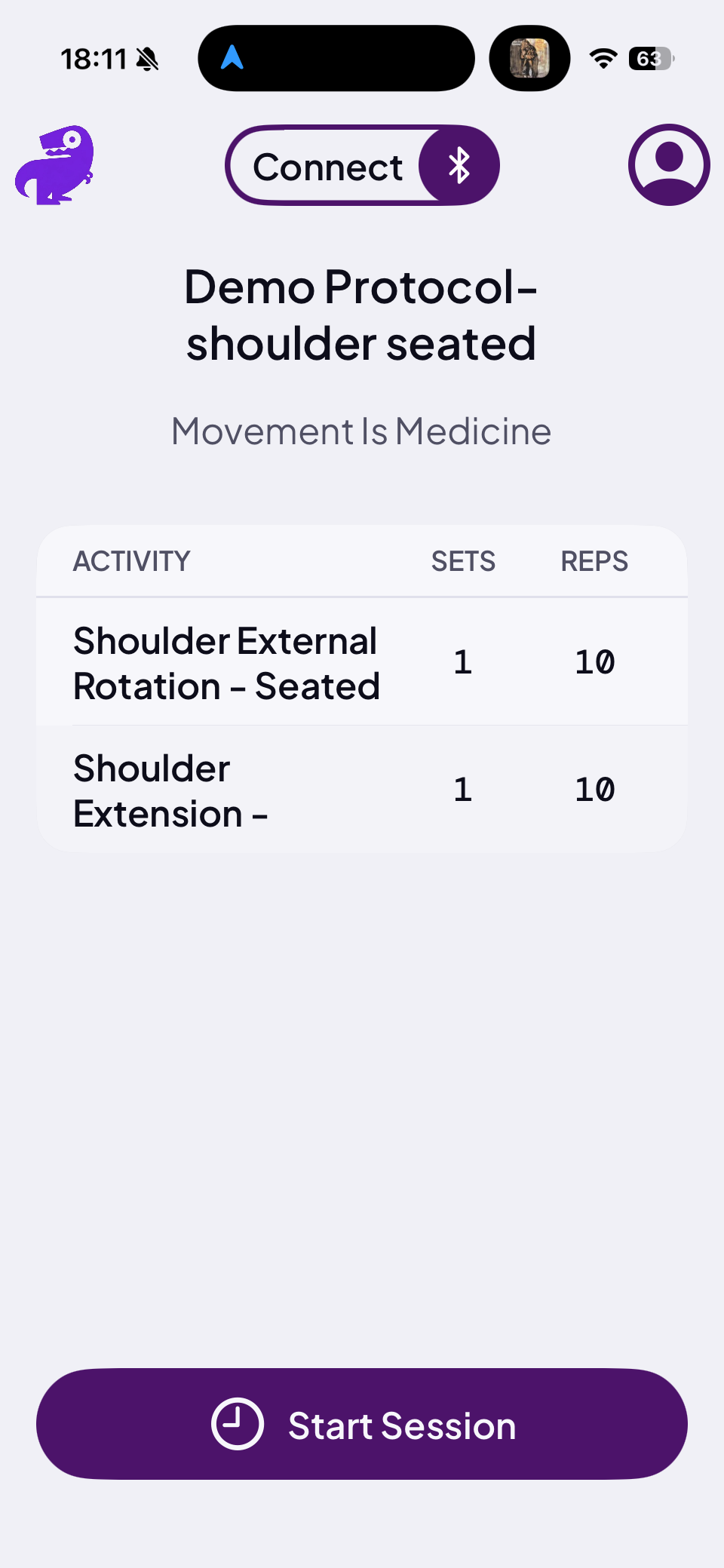
Tap Connect at the top of the screen.
-
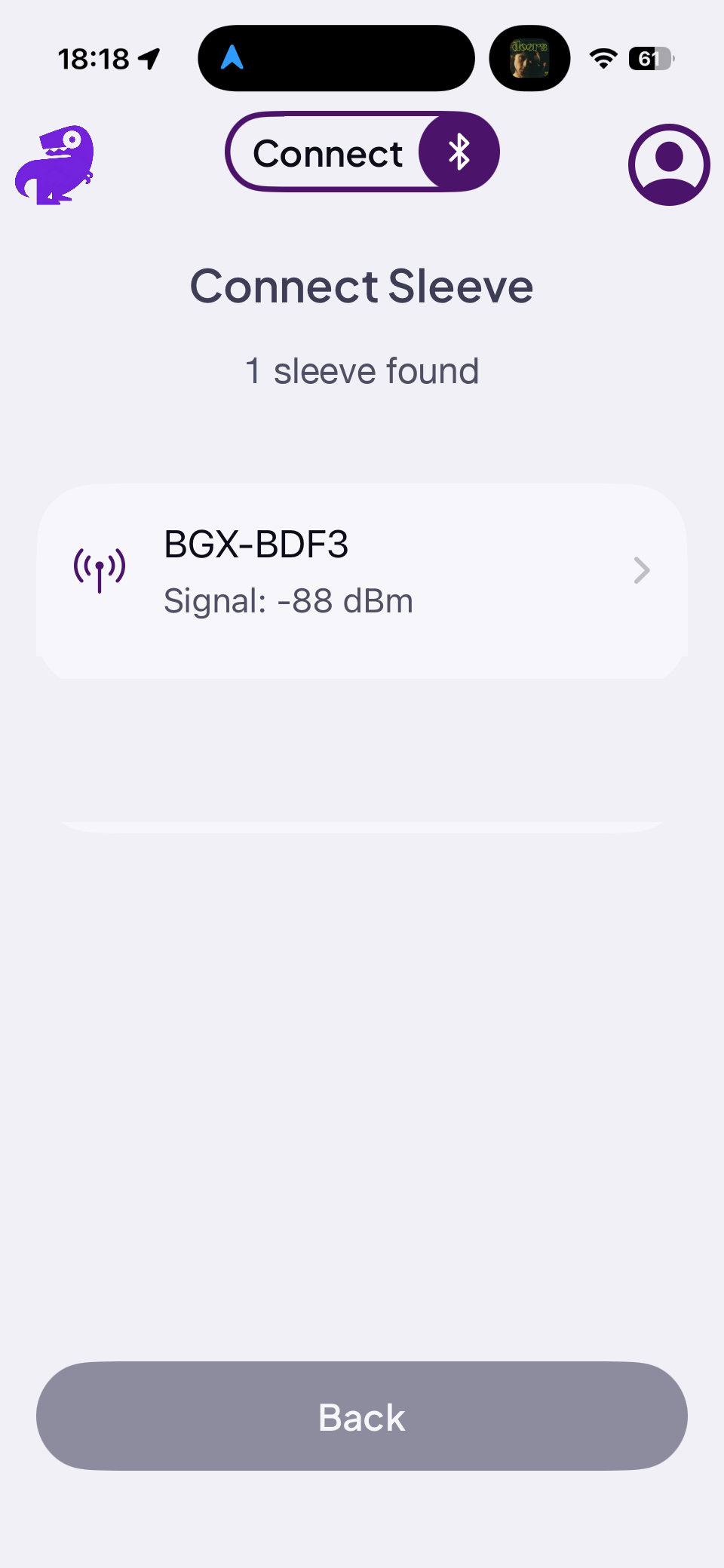
The Connect Sleeve screen appears and scans for nearby sleeves — yours will show up as BGX____ (BGX followed by four characters), along with its signal strength. Select your device.
-
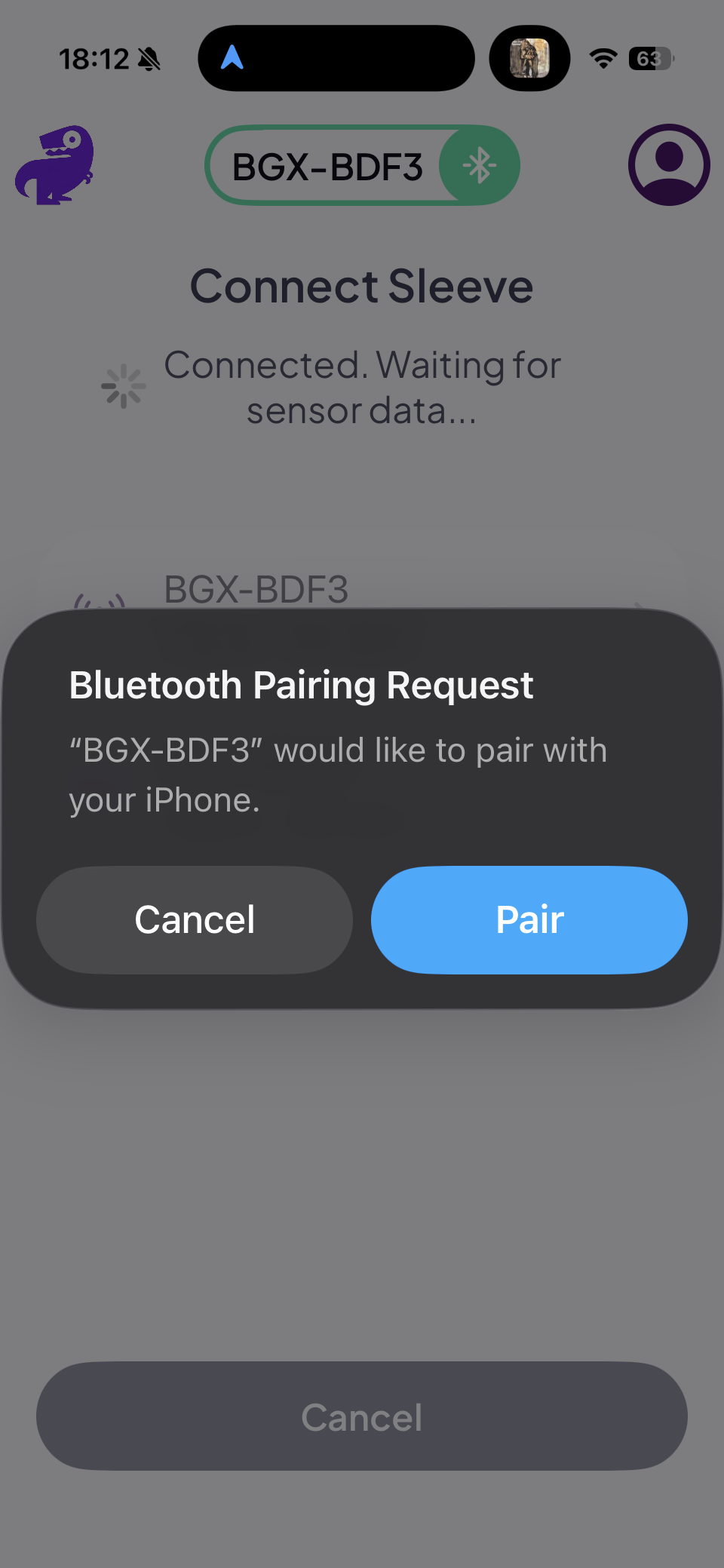
Your phone shows a Bluetooth Pairing Request — tap Pair.
-
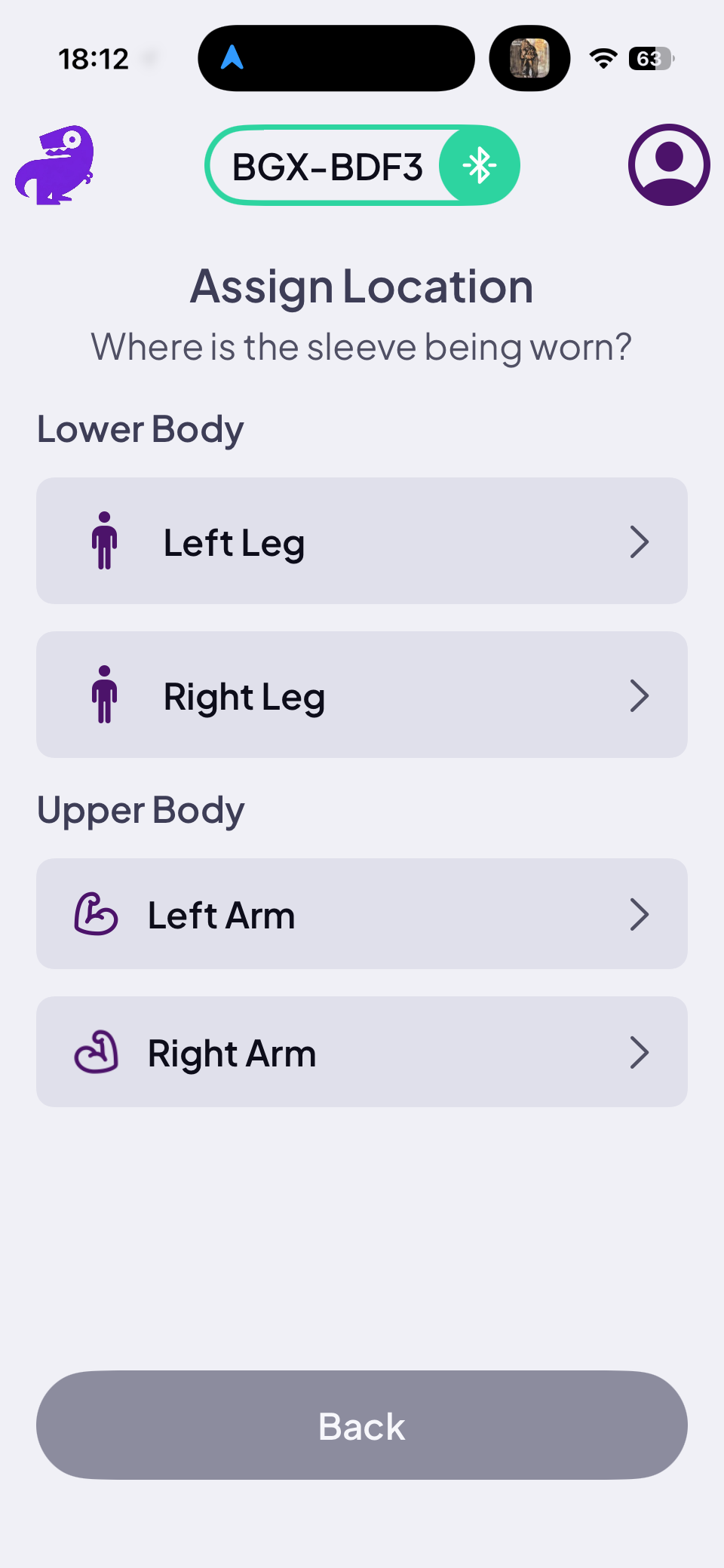
Assign Location — select where the sleeve is worn (Left Leg, Right Leg, Left Arm, or Right Arm).
After assigning your location, the rest of calibration depends on which sleeve you have. Follow the column for your sleeve — the arm sleeve calibrates in a single pose, while the leg sleeve uses a short two-position routine.
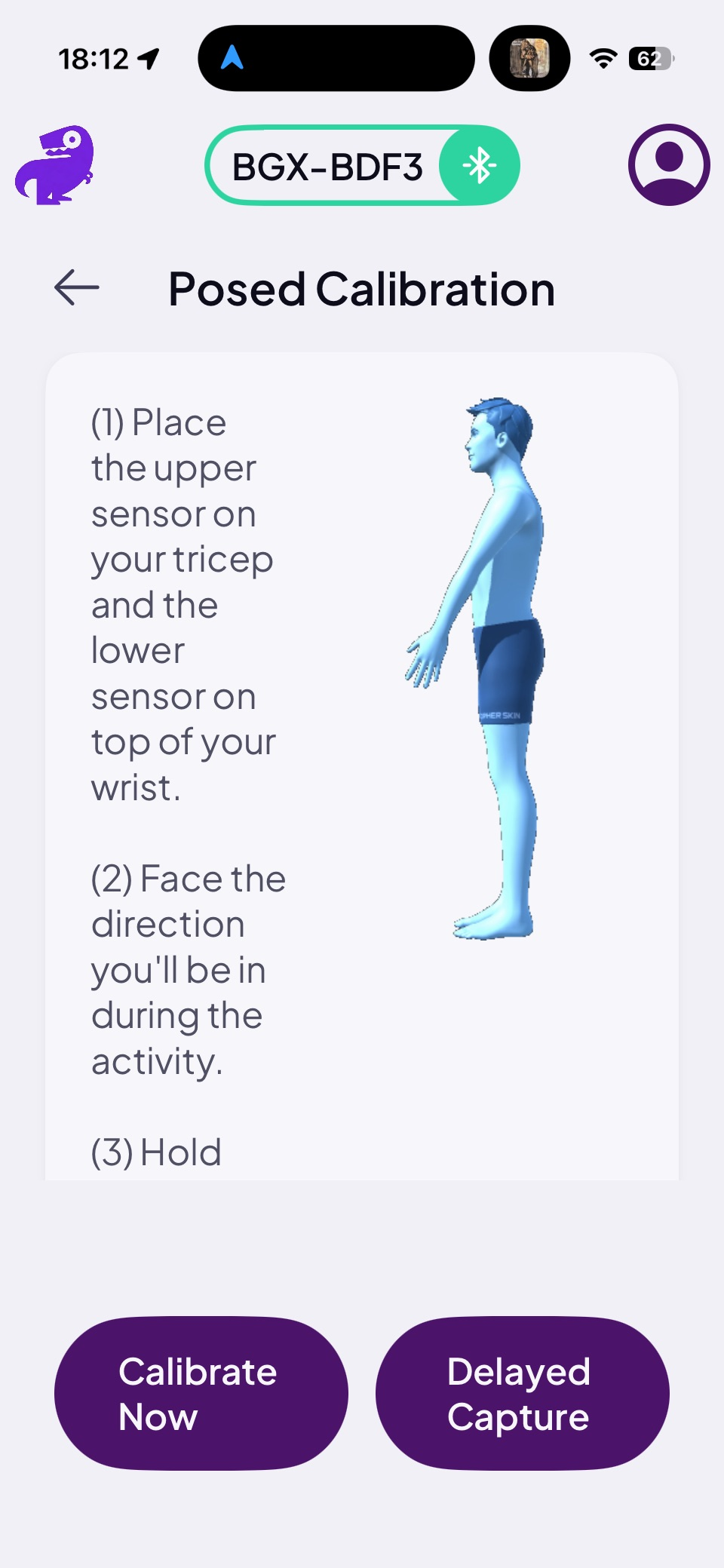
Posed Calibration — place the upper sensor on your tricep and the lower sensor on top of your wrist. Face the direction you’ll be in during the activity. Hold the pose, then tap Calibrate Now. If you need a few seconds to get into position before the app records, tap Delayed Capture for a short countdown.
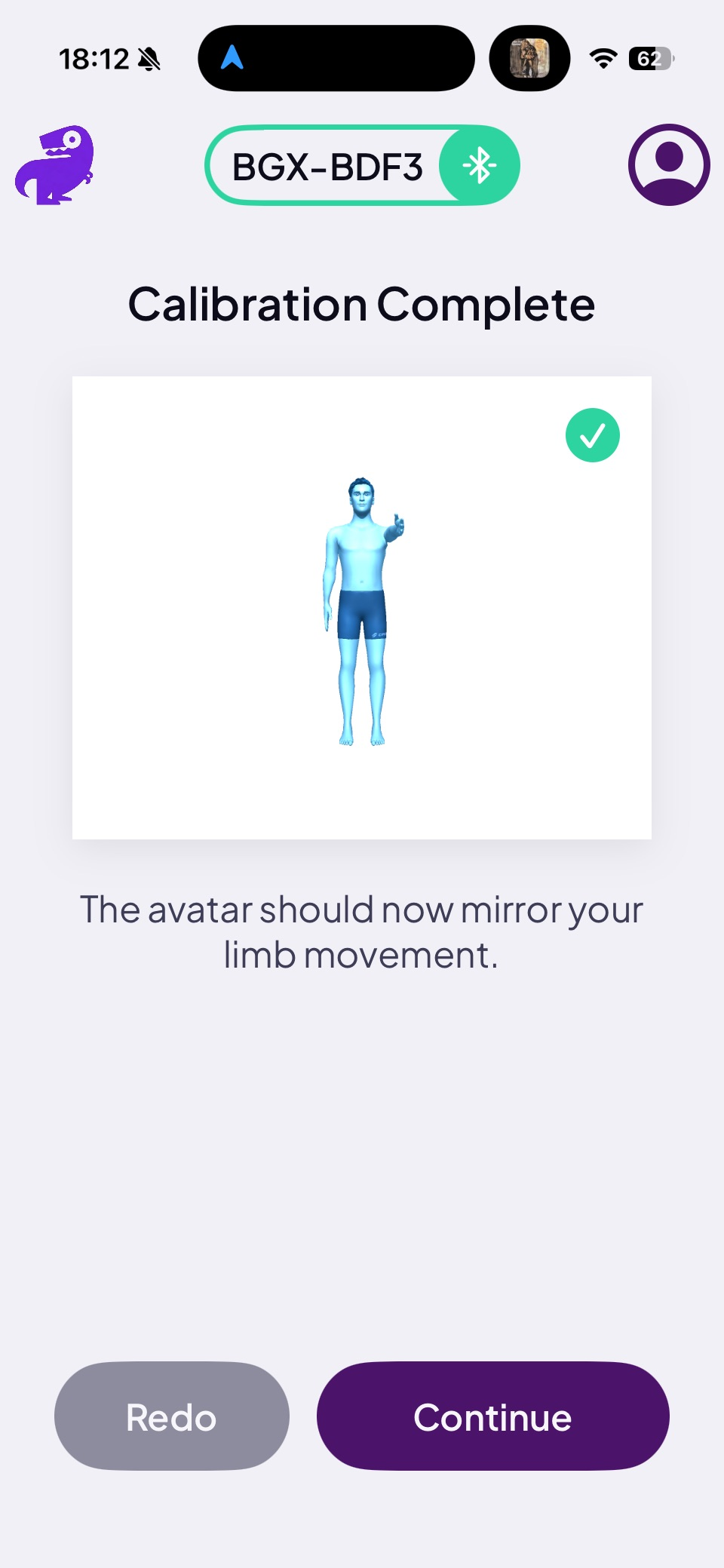
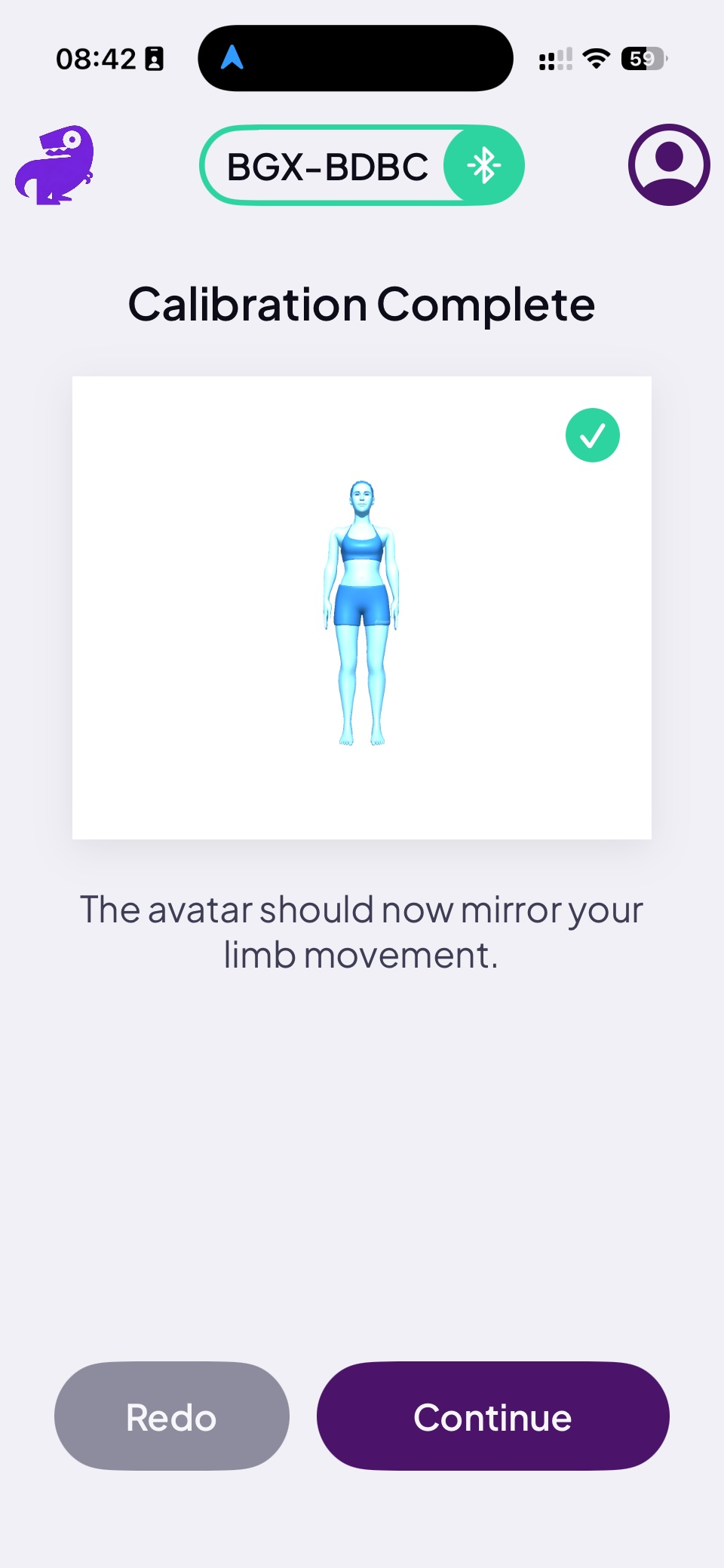
When you see Calibration Complete — “The avatar should now mirror your limb movement” — tap Continue.
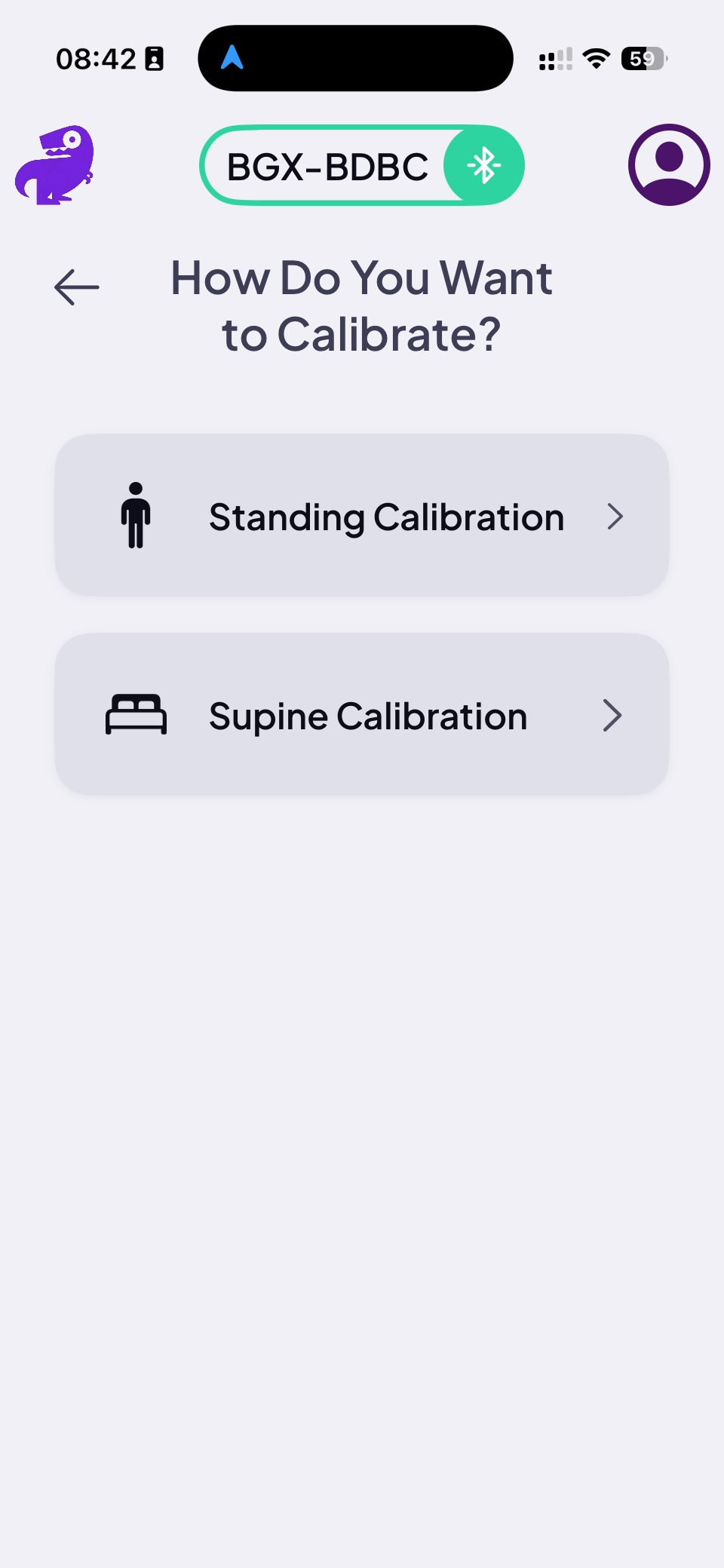
Choose how to calibrate — pick Standing Calibration if you can stand comfortably, or Supine Calibration if you need to lie on your back.
Review the two positions — the app previews the two short poses you’ll hold during calibration. When you’re ready, tap Begin Calibration.
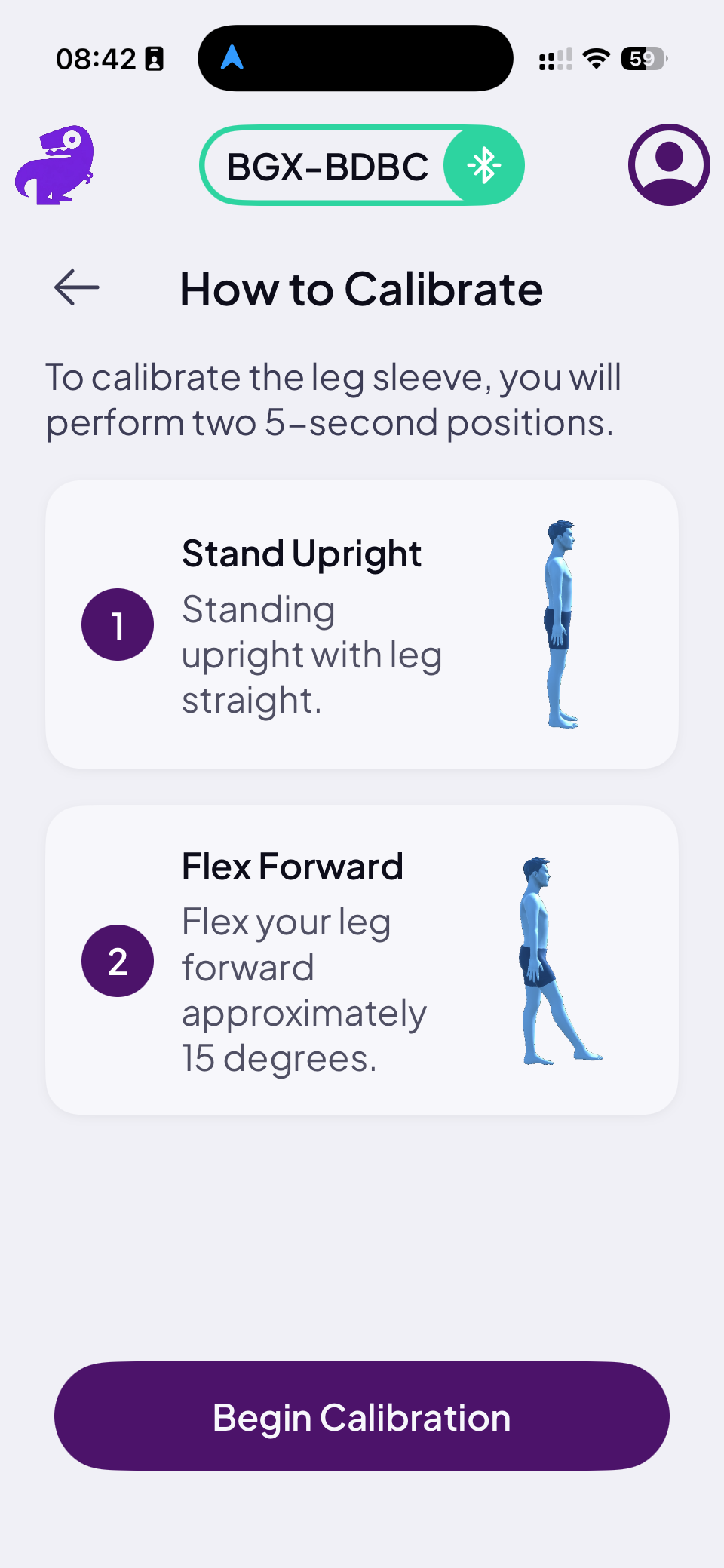
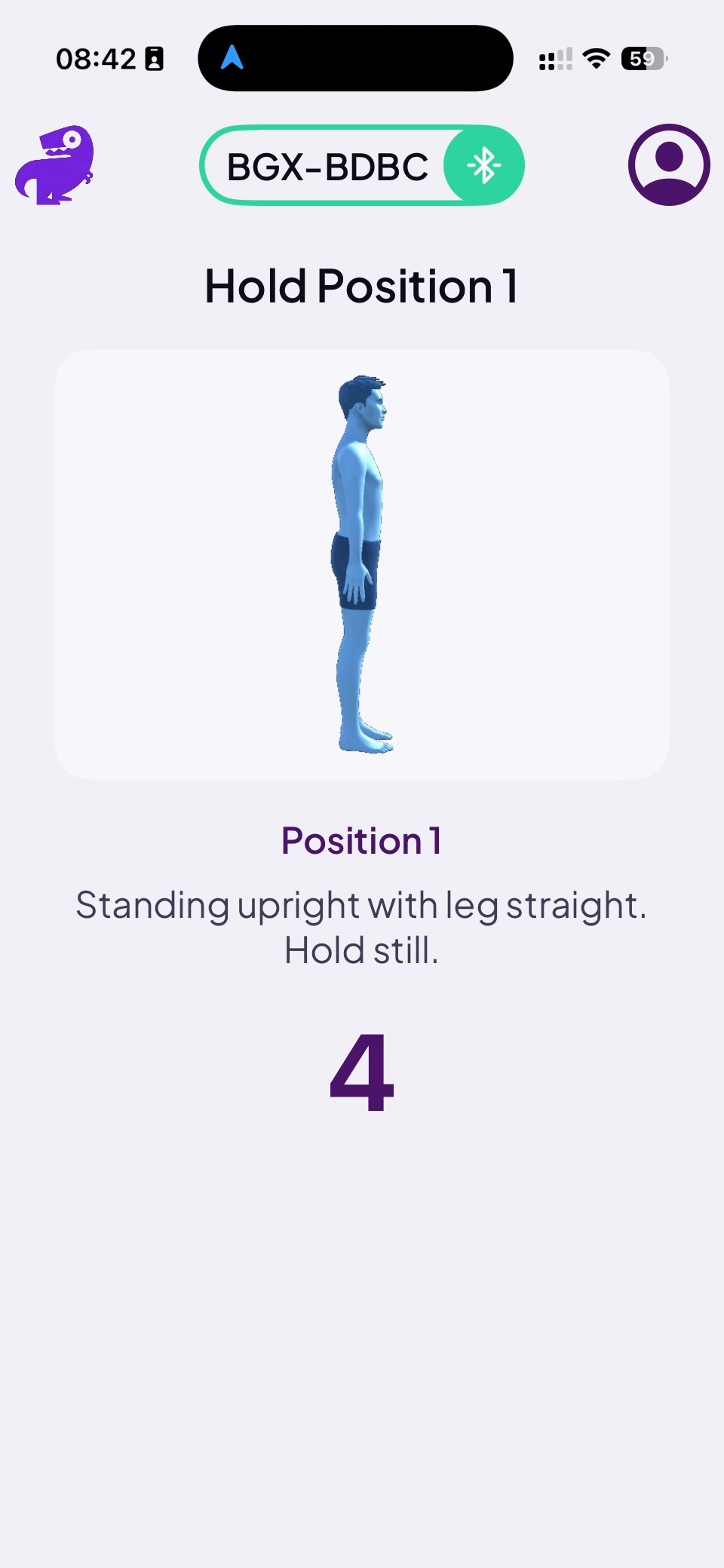
Hold Position 1 — stand upright with your leg straight (or lie supine with your leg straight) and hold still through the 5-second countdown.
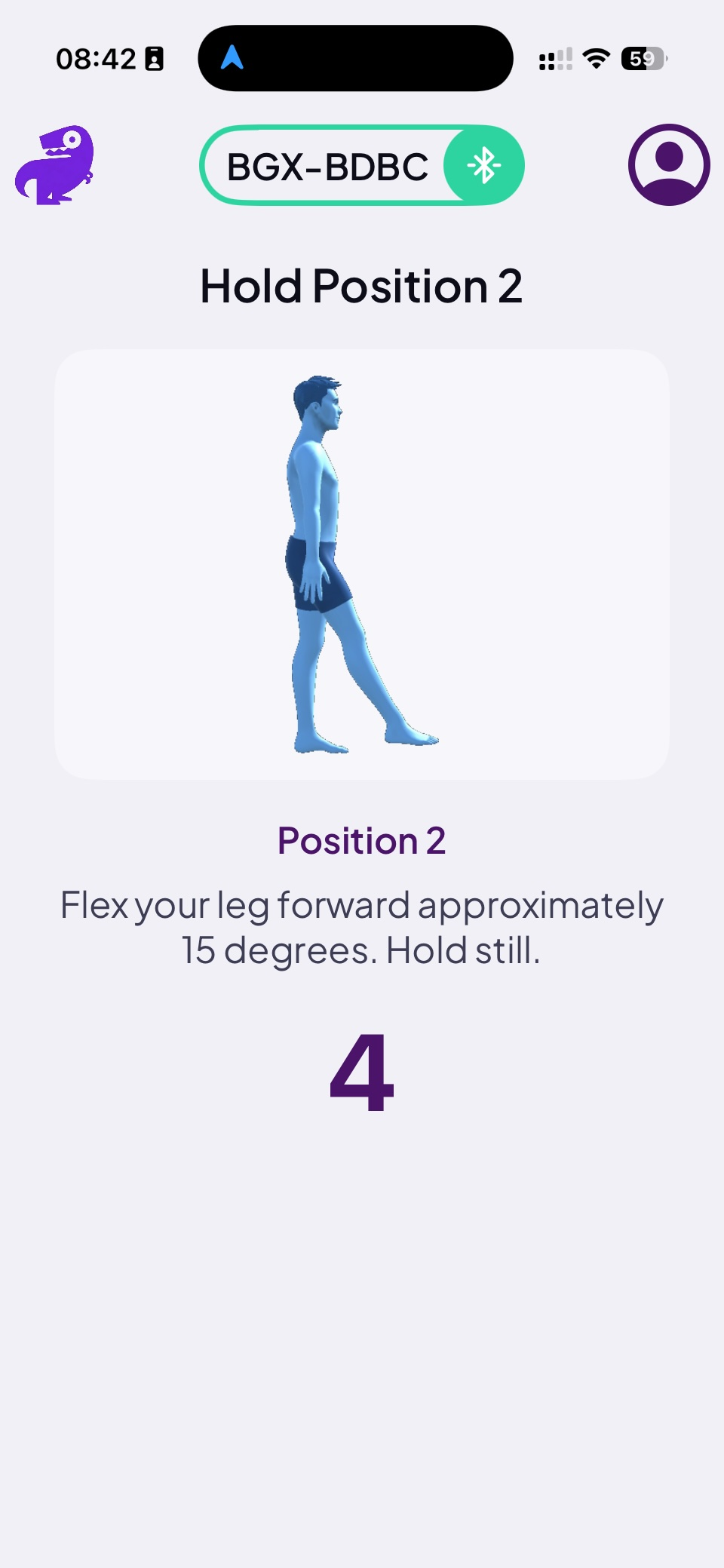
Hold Position 2 — flex your leg forward about 15° and hold still through the 5-second countdown.
When you see Calibration Complete — “The avatar should now mirror your limb movement” — tap Continue.
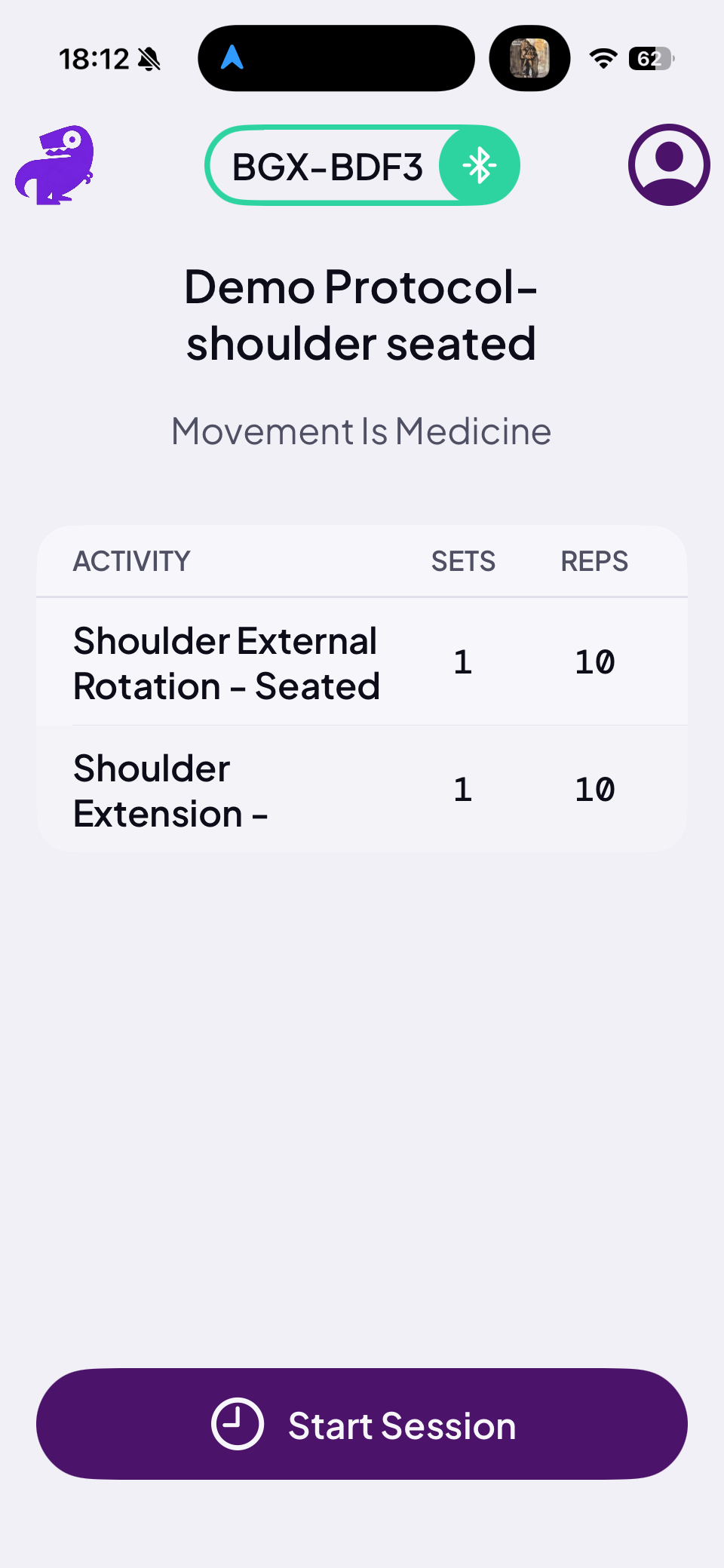
You’re paired and calibrated. The Connect pill at the top of the screen now shows your device ID in green.
TIP
Check your battery any time
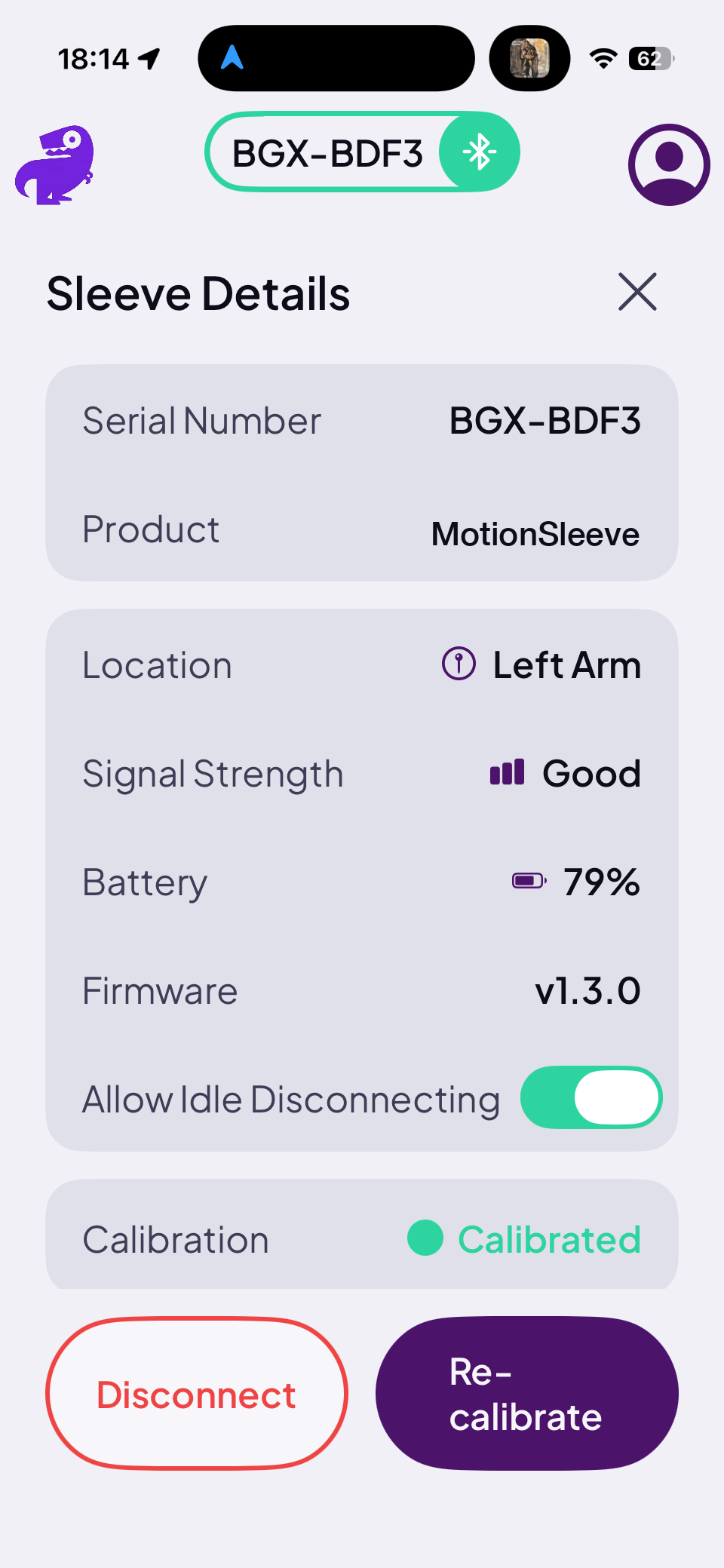
Tap the green Connect pill at the top of any screen to open Sleeve Details — battery percentage, signal strength, and calibration status. Charge the MotionSleeve whenever the battery is running low.
Step 4 — Start your first session
From the home screen showing your prescribed protocol, tap Start Session. The app walks you through each activity:
-
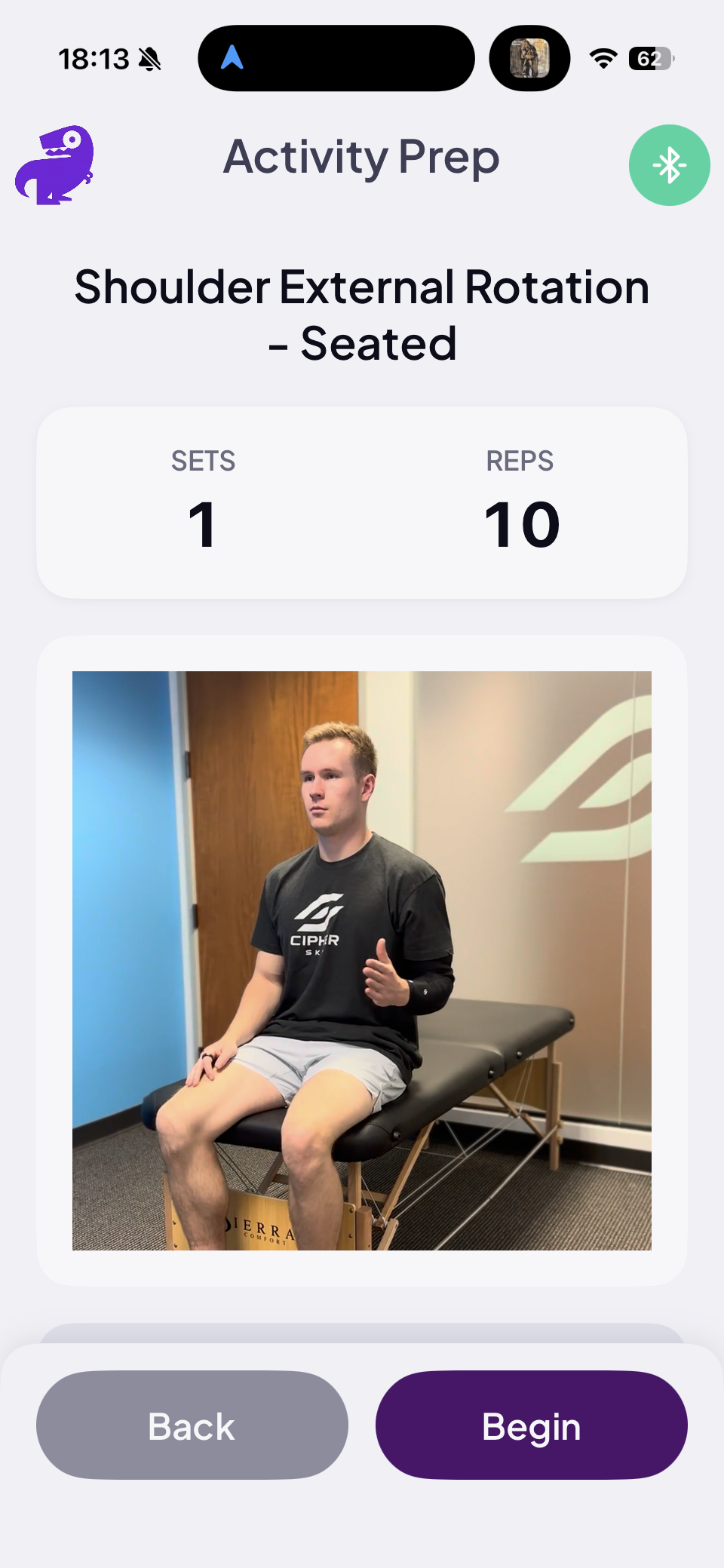
Activity Prep — shows the exercise name, sets and reps, and a reference photo of the position. Tap Begin when you’re ready.
-
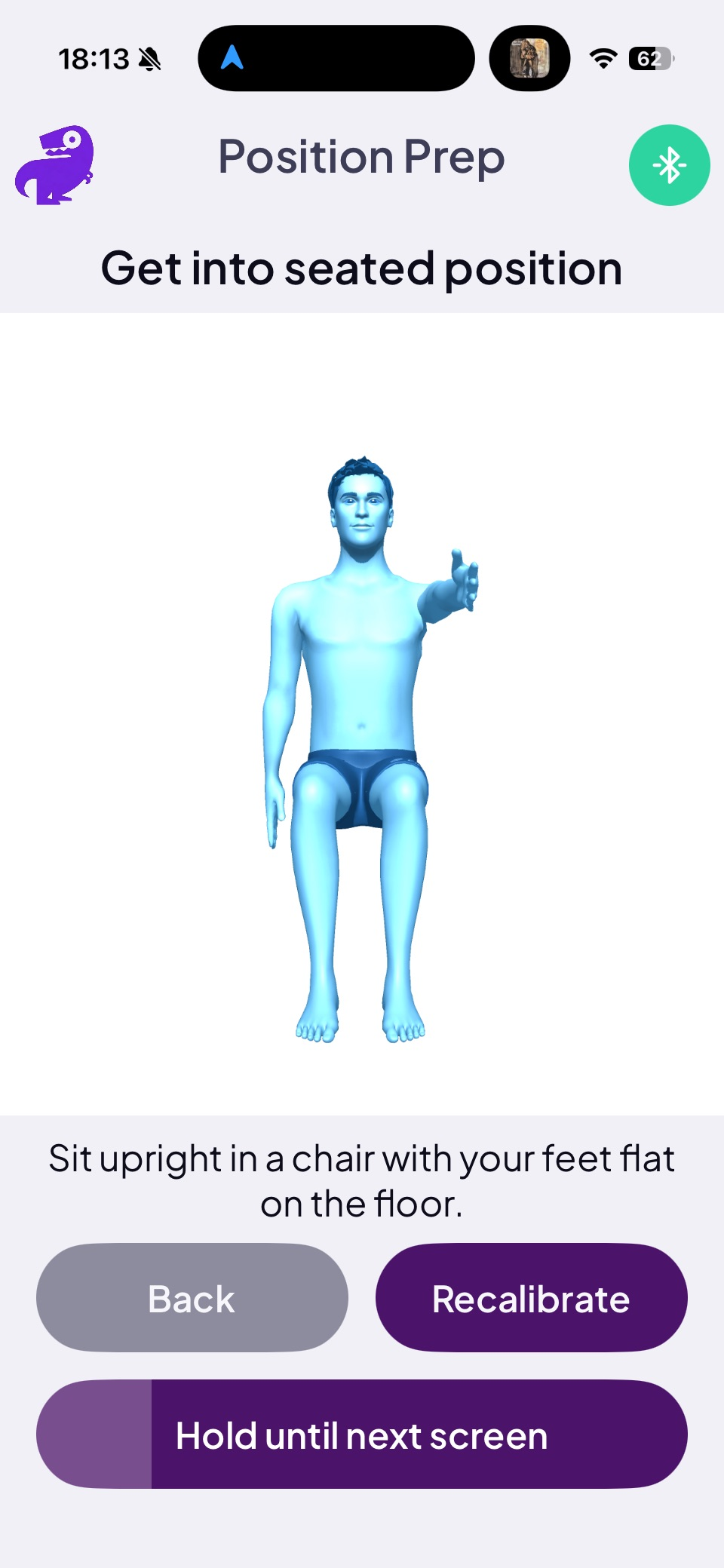
Position Prep — get into the starting position the app describes (e.g., “Sit upright in a chair with your feet flat on the floor”). When you’re in place, hold until the next screen.
Upper body 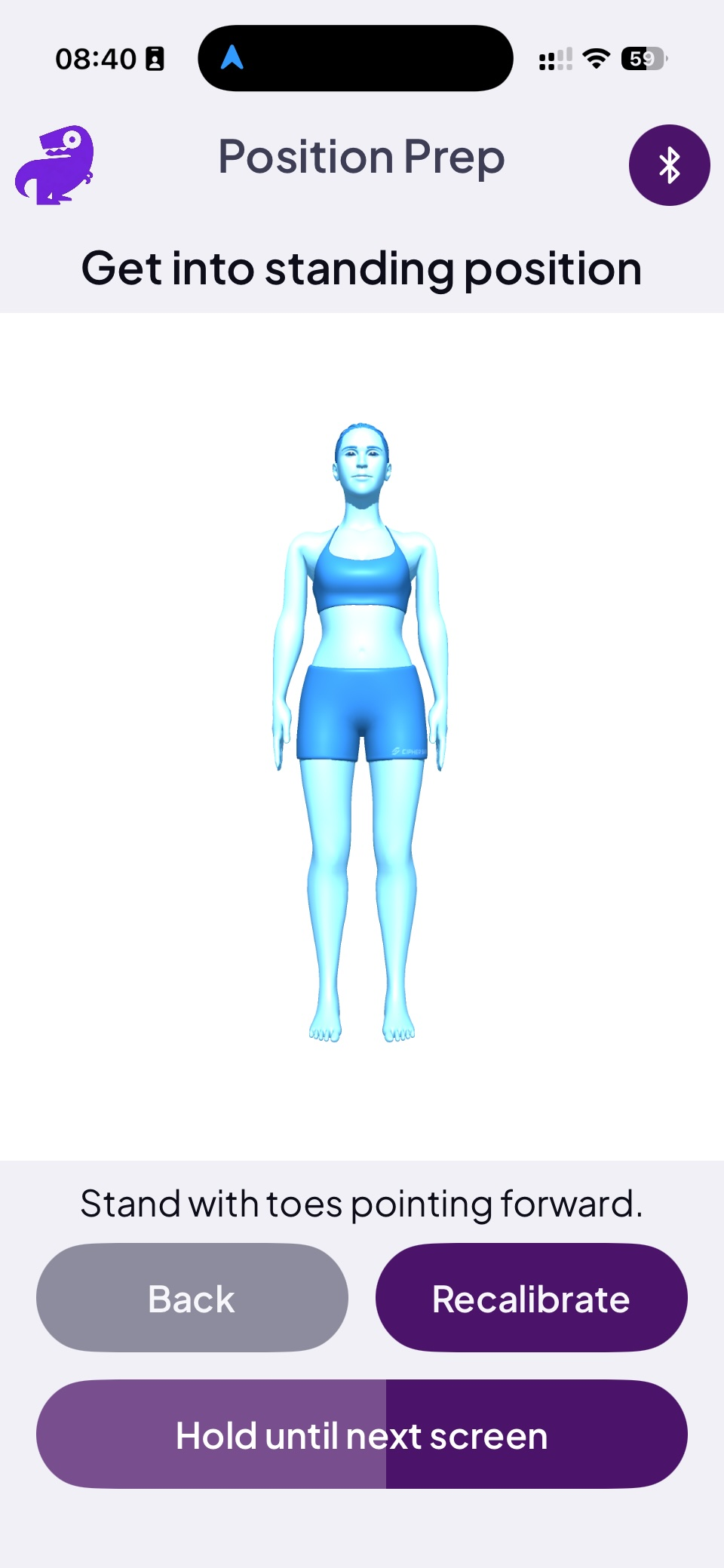
Lower body -
Perform the activity — the avatar mirrors your movement, the dial shows your peak angle against the target, and the app counts your reps and sets automatically. Activities may be active ROM (you move the joint using your own muscles) or passive ROM (an external force — your other hand, a therapist, or equipment — moves the joint while your muscles stay relaxed), depending on what your care team prescribed. Tap Complete when you’ve finished the set.
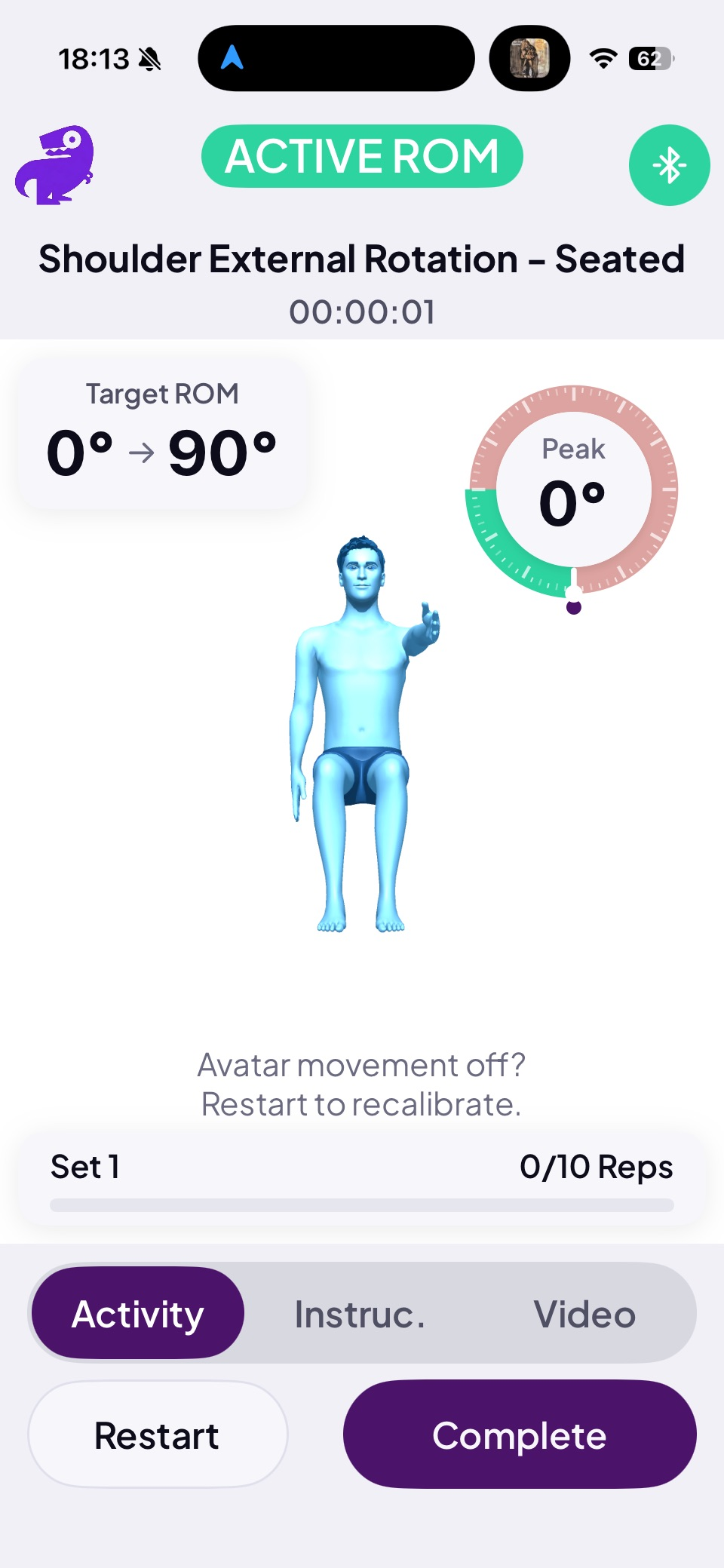
Upper body 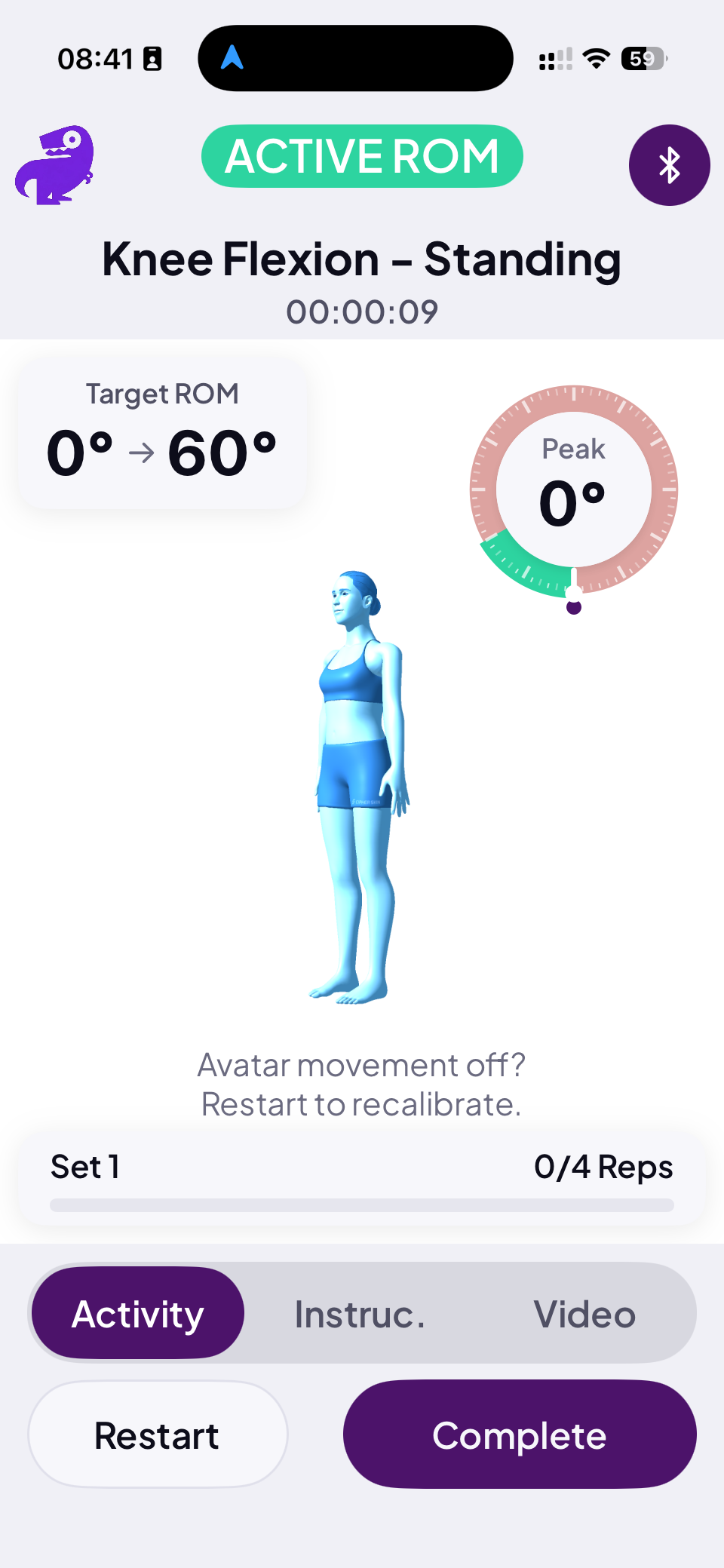
Lower body -
Activity Summary — after each activity, add any notes for your care team and tap Submit to move on.
-
The app moves to the next activity. Continue until all activities are done.
TIP
Need to skip an activity?
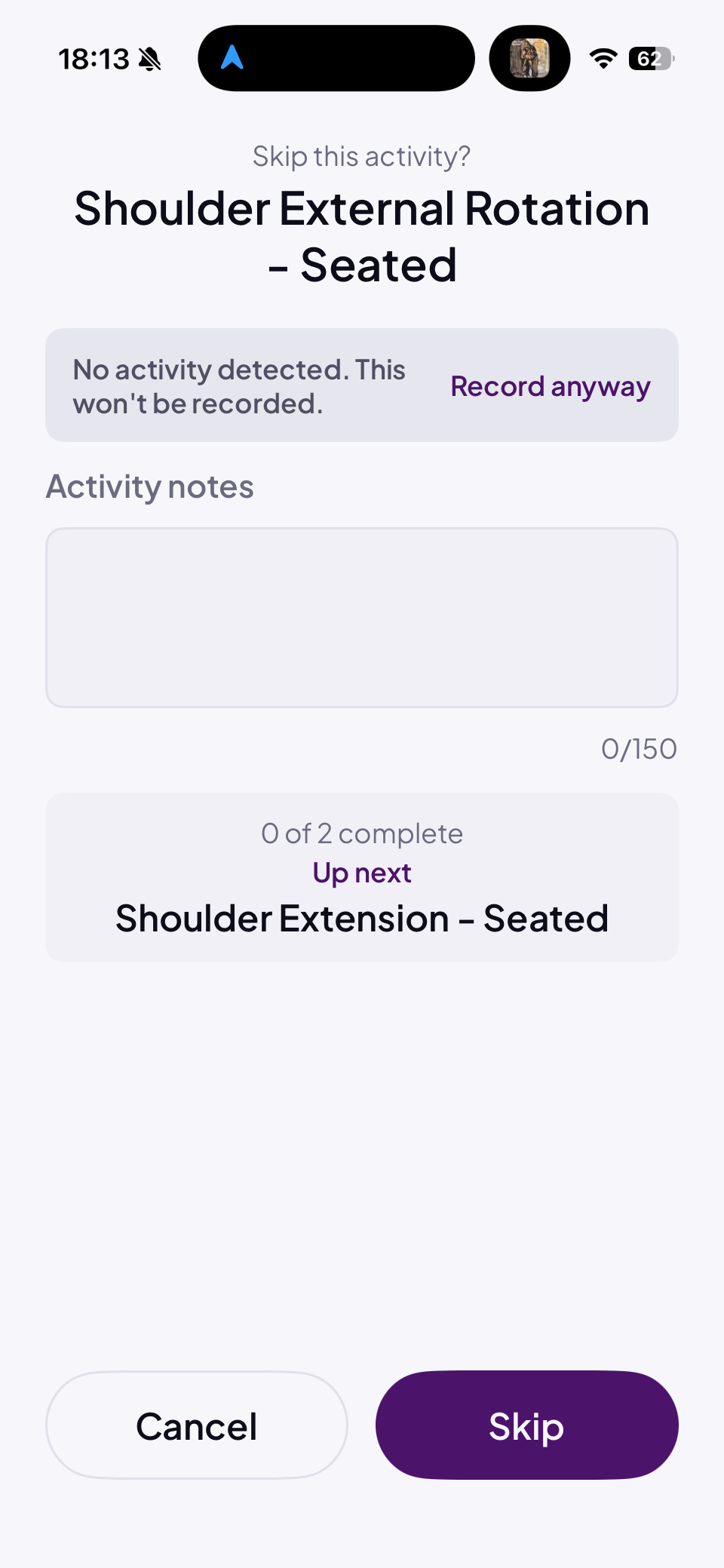
If you can’t or don’t want to do an activity, tap to exit and the app gives you the option to Skip with optional notes for your care team. If you did the movement but the sensors didn’t pick it up, you can also tap Record anyway.
TIP
Changing position between activities? Recalibrate.
Calibration is tied to the position you calibrated in. When your protocol moves you from standing to sitting, standing to supine, or otherwise changes position between activities, the app automatically prompts you to recalibrate the sleeve before the next one. Moving your foot position after calibrating also requires a recalibration before the next activity. If you move by accident, simply tap Recalibrate to correct any errors.
After your last activity:
-
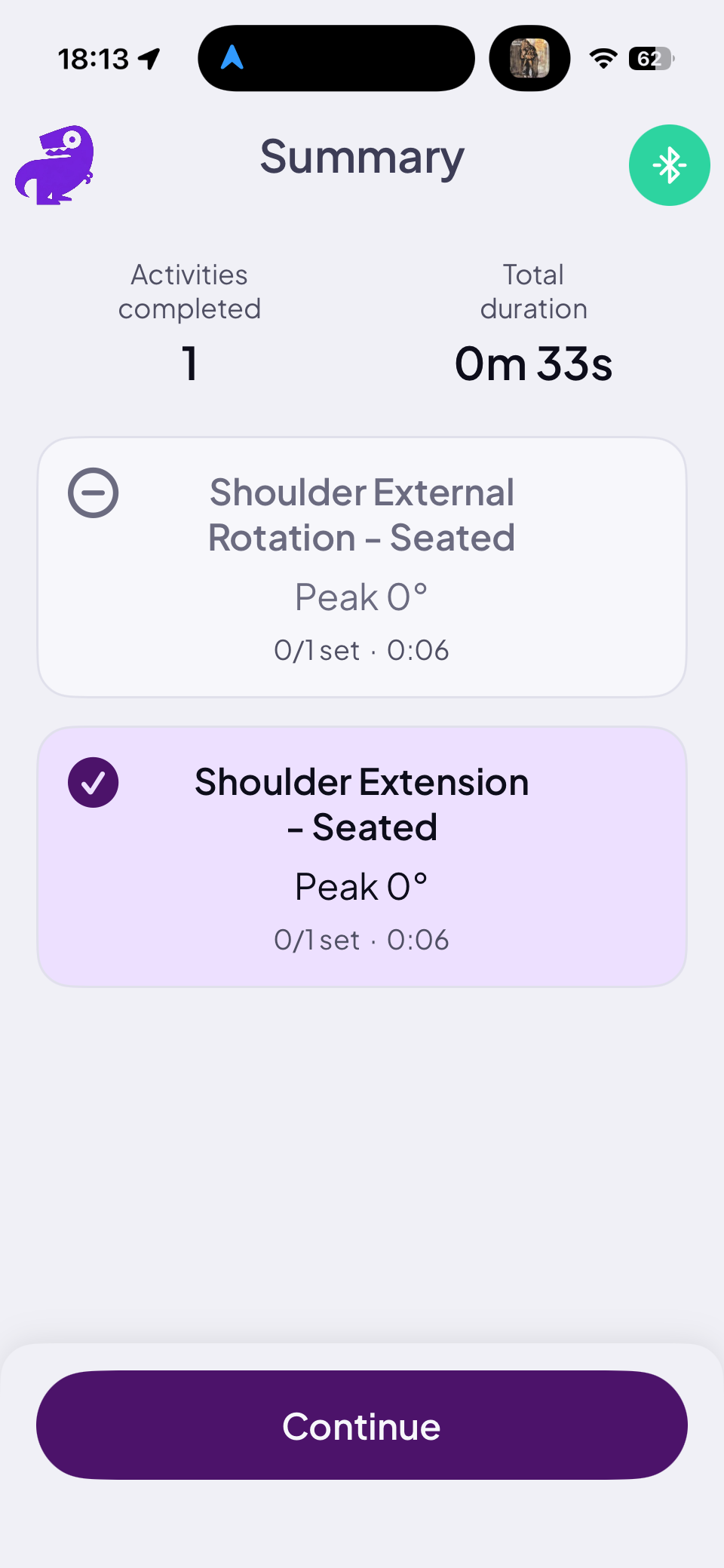
Summary — review activities completed and total duration. Tap Continue.
-
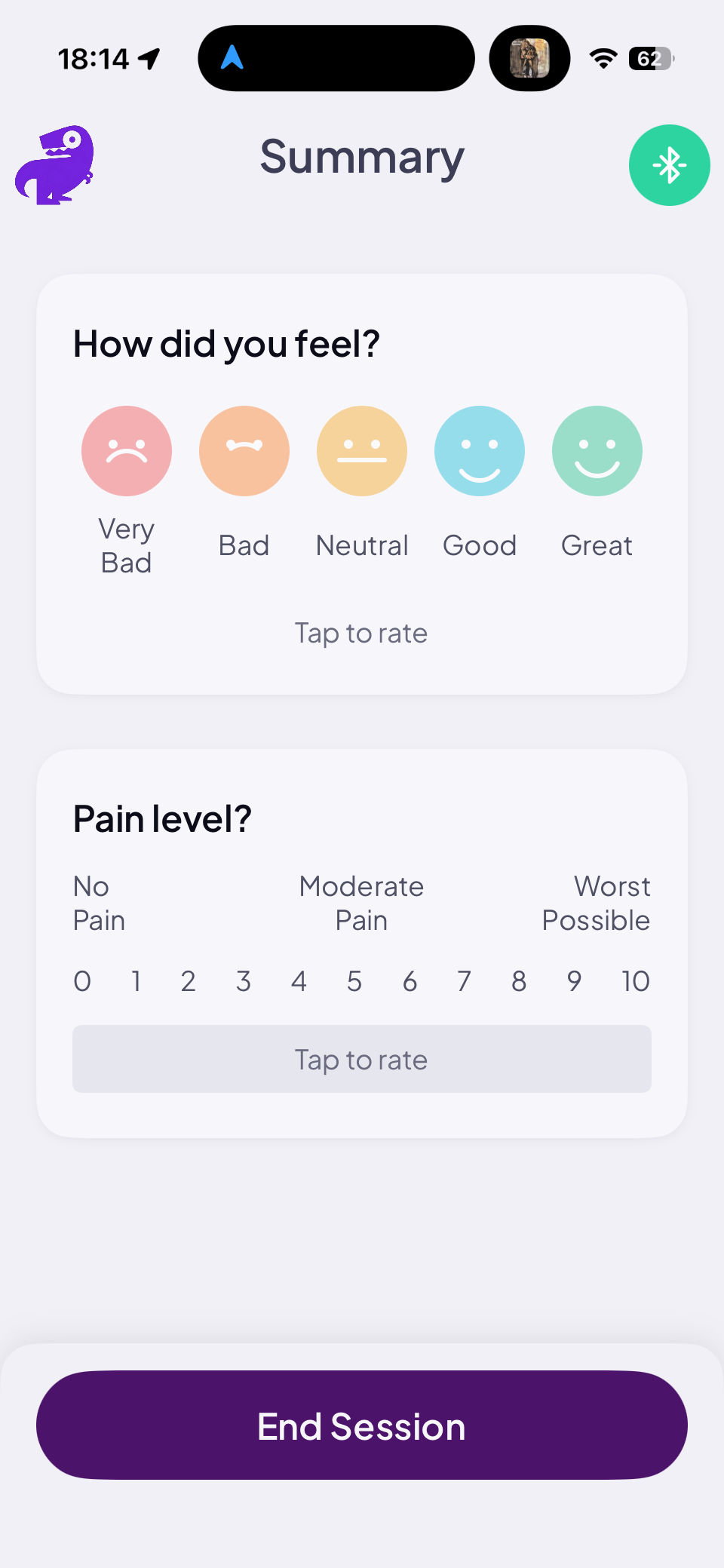
How did you feel? and Pain level? — rate the session. These go to your care team.
-
Tap End Session.
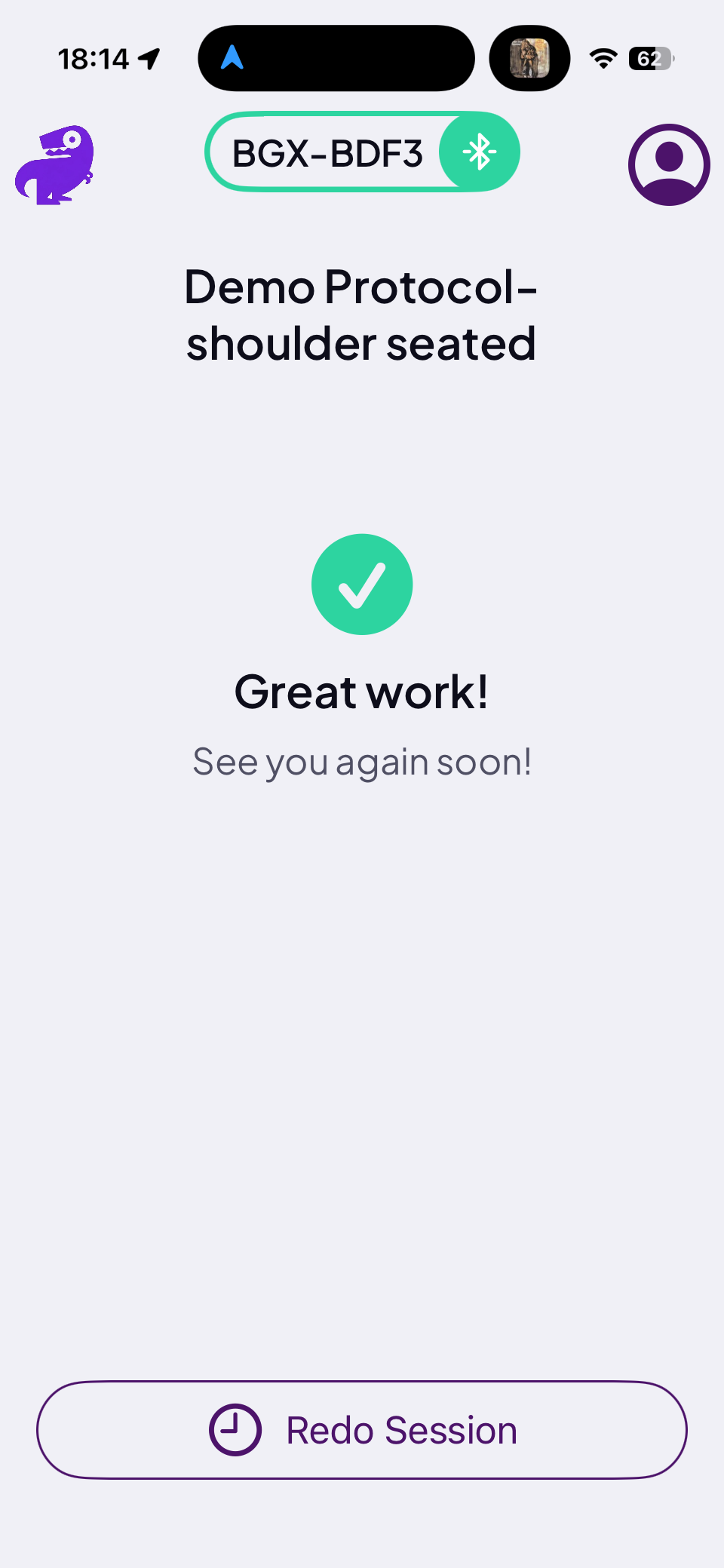
You’ll see “Great work! See you again soon!” — that’s it.
SUCCESS
You're done
Your care team sees each session’s data — and any notes you leave — in their dashboard, and adjusts your program based on what they see. If something needs attention, they’ll reach out.
What to do if something goes wrong
- App won’t find the device: make sure Bluetooth is on and can discover new devices, and move the MotionSleeve closer to the phone. Make sure the device is charged. The sleeve wakes with motion or when the phone is actively trying to connect.
- App sees the device but fails to connect: the sleeve’s battery is probably low. Plug it in to charge, then try again.
- Problems putting on the MotionSleeve: contact us for help or an exchange at no cost.
- Anything else: see the full troubleshooting guide.