— For Providers
You own the recovery risk
after the surgery.
We make it visible,
every rep, every day.
Track each patient's recovery trajectory between visits. Objective range-of-motion (ROM) from the wearable. Subjective patient-reported outcome measures (PROMs) — pain, function, how the patient is feeling — from the patient app. Together, that gives you visibility into every patient between visits — who's on-track, who needs attention. And every rep is documented, so outcomes are measurable and the data is there when you need it.
— On the Federal Supply Schedule
Contract 36F79726D01161 · Available to federal agencies — device, onboarding, monitoring, and dashboard, bundled
Procurement, simplified. For other settings, we'll walk through options with your team.
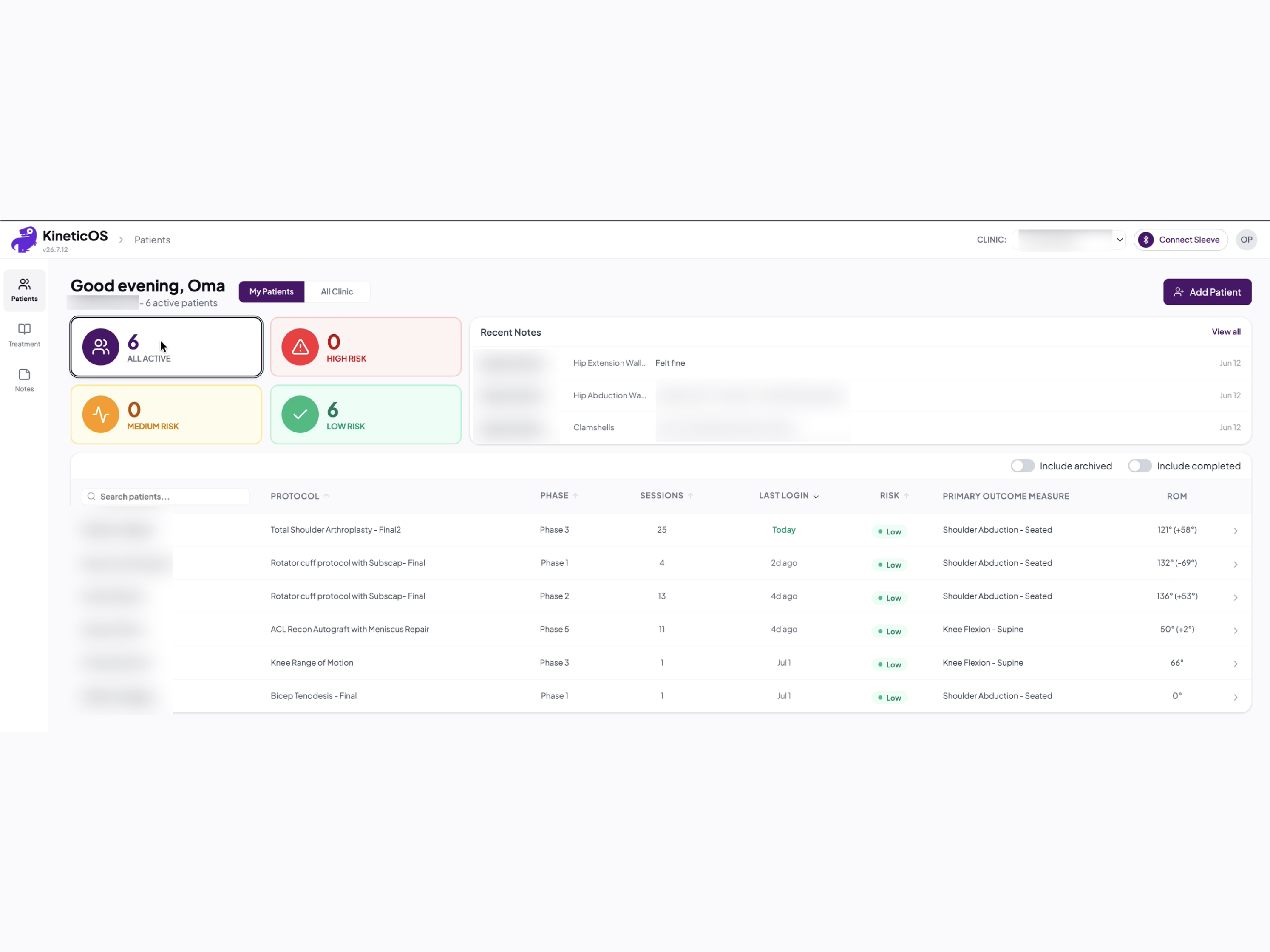
Triage at a glance
Color-coded panel view — green, yellow, red by adherence and ROM trends. Spot who needs attention without combing through charts.
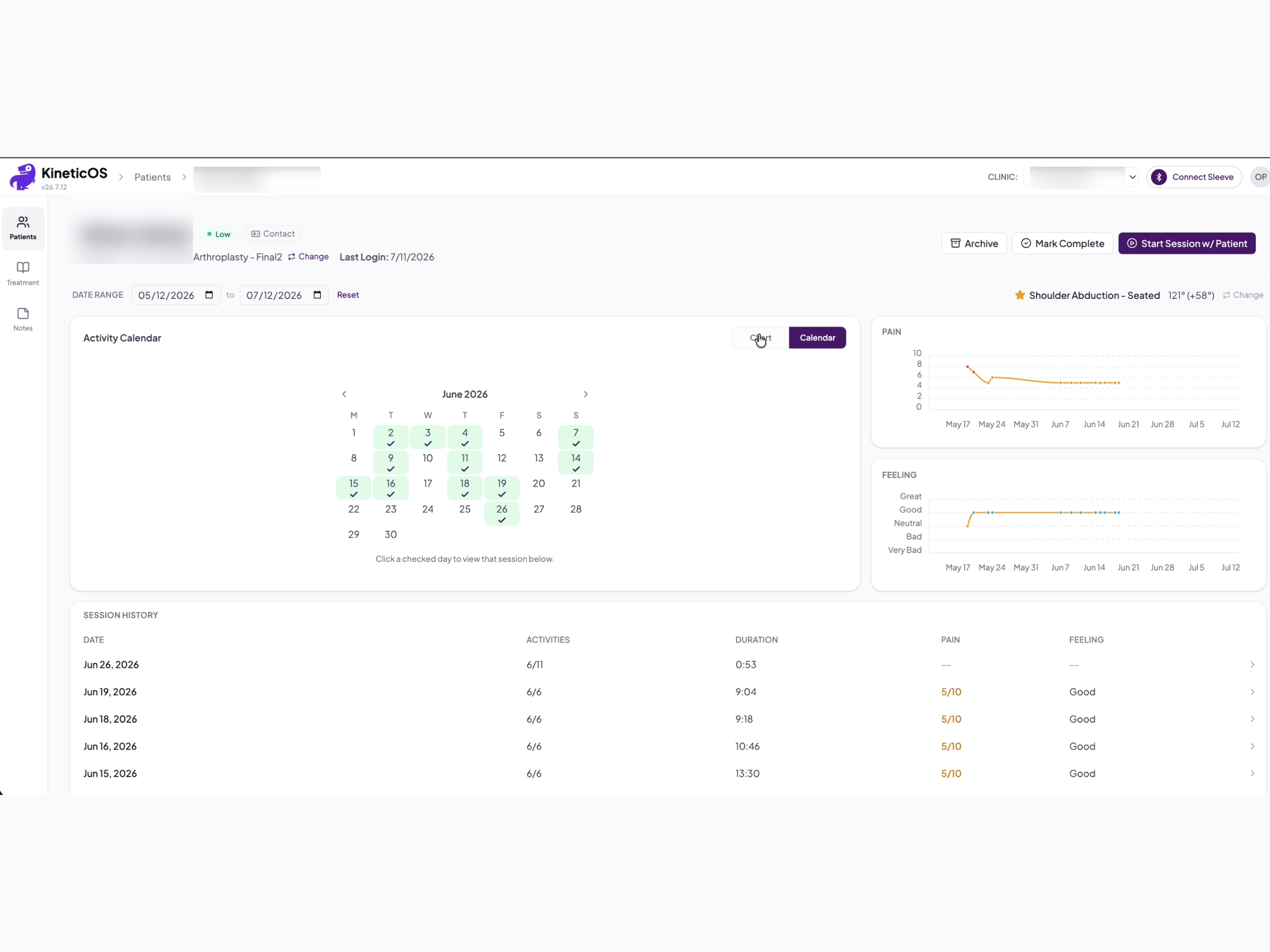
Monitoring and alerts
Built-in alerts flag deviations in ROM or adherence and notify the care team, so your team can decide when to reach out.
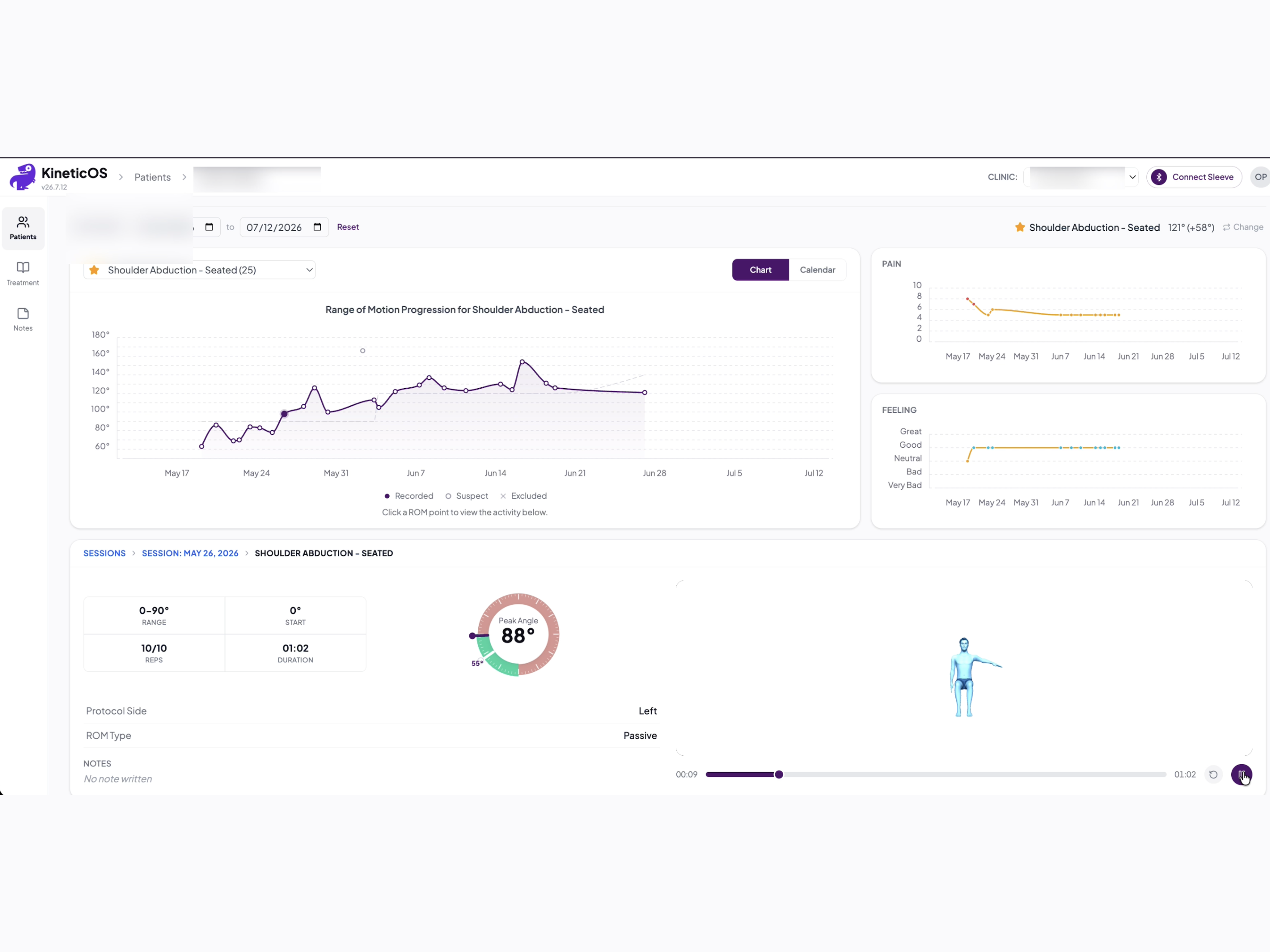
Every rep, documented
Objective ROM trajectory alongside patient-reported pain and function, every session. One complete recovery record. Feeds your reporting, your research, and your audit trail.
— How we use AI
AI surfaces patterns.
Clinicians decide.
AI flags deviations in ROM and adherence, summarizes sessions, and stratifies which patients need attention. Clinical decisions — escalation, adjustment, intervention — always stay with your care team. AI never modifies protocols, makes diagnoses, or contacts patients on its own.
— Built around your workflow
We handle the logistics.
You handle the care.
MotionSleeve integrates into your existing workflows. Providers go from data to decision without changing how they work. We remove the operational burden — so your team can focus on what matters most: the care.
Device management
We manage device delivery, returns, and inventory — no stocking, no shipping logistics, no device-loss risk on your clinic.
Onboarding & support
Provider onboarding is a one-time setup — we work with your team to optimize your existing workflows, not reinvent them. Patients self-onboard, with OpenMotion handling all device, app, and technical support directly. Medical questions always go to the care team.
Protocol management
Designed and administered by your care team — your PT, the treating surgeon, or an outside PT. Customizable and shareable across providers and clinics.
— How it works
Prescribe. Recover. Review.
01
Surgeon directs
The treating surgeon sets the rehab protocol at point of care — they know the repair best.
02
Patient recovers at home
The patient does their prescribed exercises. The app guides them. Data flows back to the care team.
03
Care team reviews
The care team reviews sessions on the KineticOS dashboard — ROM trajectory, adherence, patient-reported outcomes — and adjusts the protocol as recovery progresses.
— FAQ
What providers are asking.
What joints are supported?
+
Knee, hip, shoulder, and elbow — with active and passive range-of-motion on each.
Can we use this for non-post-surgical patients?
+
Yes. MotionSleeve also supports MSK rehab and monitoring outside the post-operative window.
What types of exercises can we prescribe?
+
Both active and passive ROM exercises. Our library includes hundreds of pre-built exercises across the supported joints, and we can add new ones on request. Your team can also assemble custom protocols from the activity library in KineticOS.
Do patients still need a physical therapist?
+
MotionSleeve is used under the direction of a treating clinician — a clinician is always in the loop. Beyond that, it's a care team decision: sometimes a PT, sometimes the surgeon directs and monitors rehab. The platform supports home exercise programs assigned by the care team, freeing in-clinic time for higher-skill work.
How do you use AI?
+
AI surfaces patterns in the data — flagging deviations in ROM or adherence, summarizing sessions, and stratifying which patients need attention. Clinical decisions — escalation, adjustment, intervention — always stay with your care team. AI never modifies protocols, makes diagnoses, or contacts patients on its own.
How is the device purchased?
+
Available to federal agencies under the VA Federal Supply Schedule (FSS Contract 36F79726D01161) — device, onboarding, monitoring, and dashboard, bundled. Billing pathways for other settings depend on payer and setting — our team will work through the specifics with yours.
How does onboarding and support work?
+
Provider onboarding is a one-time setup with your practice. Patients self-onboard, with OpenMotion handling all device, app, and technical support directly. Medical questions always go to the care team.
Does this integrate with our EHR?
+
Yes — we can export to whatever format your EHR uses (HL7, FHIR, CSV, PDF) and tailor the pipeline to your system. For Epic, that can include session reports in the Media tab and alignment with your order workflow. Exact integration is scoped with your team during onboarding.
Can we export the data?
+
Yes. Per-patient session data exports from the dashboard as PDF or CSV. Custom reporting templates available on request.
Where does the data live?
+
AWS US-only, AES-256 at rest, TLS 1.2+ in transit. HIPAA compliant. BAA available.
— The Platform
See it
in action.
Schedule a clinical demo. We'll walk through the device, the dashboard, and the provider experience.